Key ideas
Core concepts
- Information that disappears quickly must be held in working memory, creating extraneous cognitive load. Slideshows are a common source: information vanishes when slides advance, forcing students to remember whilst learning new content.
- Permanent reference materials, such as booklets or written notes, store information externally so working memory can process rather than remember.
Connected to
Cognitive Load Theory | Split-Attention Effect | Modality Effect | Use Booklets | Fluency
The transient information effect is the increase in cognitive load that occurs when information presented to learners is temporary and quickly disappears (Leahy & Sweller, 2011). Working memory must hold the temporary information, creating extraneous cognitive load (Cowan, 2001). When learners cannot retain transient information long enough to process it, they understand and integrate new knowledge less effectively (Leahy & Sweller, 2011).
Slideshows
Slideshows allow teachers to direct student attention and control pacing, but they create transient information problems (Leahy & Sweller, 2011; Sweller, van Merriënboer, & Paas, 2019). Information presented on earlier slides disappears when new slides appear, forcing students to remember whilst simultaneously learning.
Slideshows
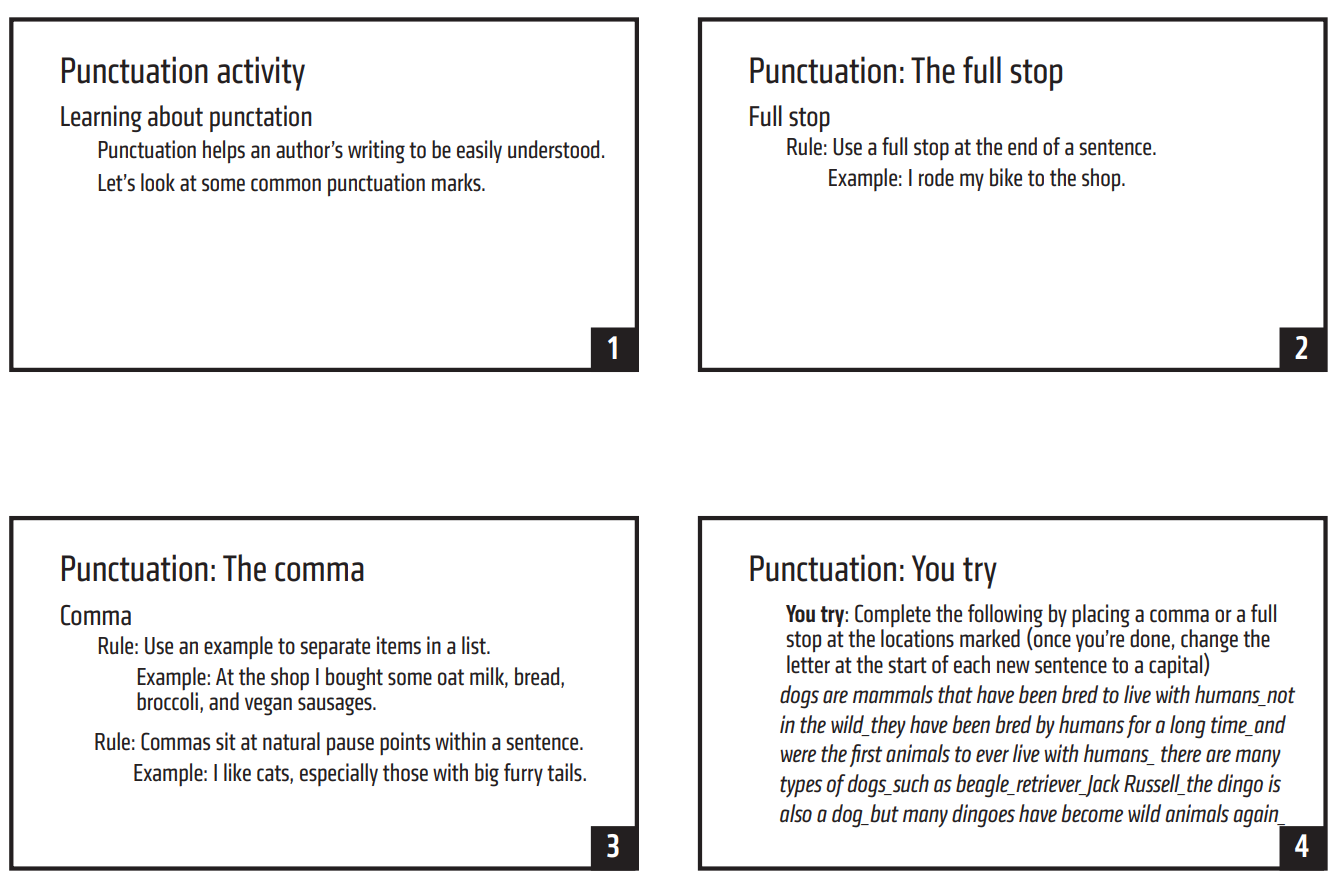
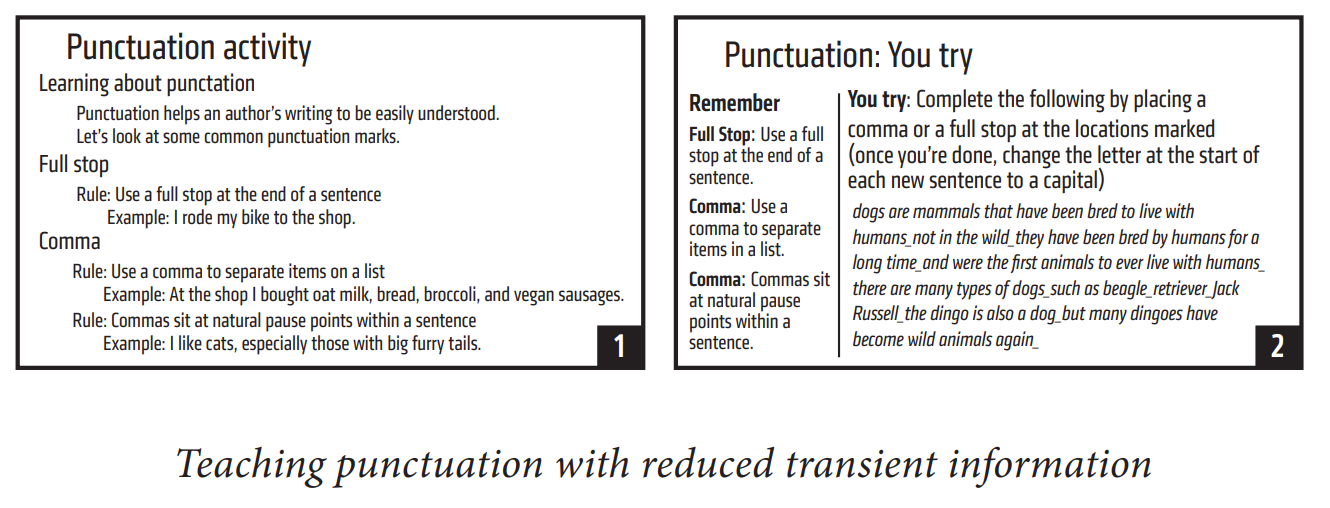
The full stop and comma are introduced in early slides, but in the fourth ‘you try’ slide, all reference to full stops and commas has disappeared. Students must hold the definitions in working memory whilst applying this knowledge to the ‘you try’ question. This imposes cognitive load for students who are not yet fluent in using full stops or commas.
Reducing transience
Three strategies reduce the transient information effect (Leahy & Sweller, 2011; Sweller et al., 2019). First, provide permanent reference materials. Information should be written down or recorded by students, not just spoken with verbal emphasis, because verbal emphasis does not create permanent access (Leahy & Sweller, 2011). Second, avoid using slides to teach new concepts, since information displayed on previous slides disappears when replaced (Leahy & Sweller, 2011). Third, use booklets where key information remains accessible throughout the lesson. External storage frees working memory for processing rather than remembering (Sweller et al., 2019).
In practice, when information matters for learning, ensure it remains accessible. Written materials provide more reliable access than spoken instructions. Before using slides for new concepts, check whether the information will remain available when students need it; booklets provide better support when it needs to persist. Working memory’s limited capacity should not be spent holding information that could be externally available.
References
Cowan, N. (2001). The magical number 4 in short-term memory: A reconsideration of mental storage capacity. Behavioral and Brain Sciences, 24(1), 87-114. https://doi.org/10.1017/S0140525X01003922
Leahy, W., & Sweller, J. (2011). Cognitive load theory, modality of presentation and the transient information effect. Applied Cognitive Psychology, 25(6), 943-951. https://doi.org/10.1002/acp.1787
Sweller, J., van Merriënboer, J. J. G., & Paas, F. (2019). Cognitive architecture and instructional design: 20 years later. Educational Psychology Review, 31(2), 261-292. https://doi.org/10.1007/s10648-019-09465-5