Key ideas
Core concepts
- When basic skills require minimal cognitive effort, working memory is freed for complex problem-solving.
- Fluency exceeds automaticity: beyond speed and accuracy, it includes flexible application and strategic thinking.
- Complex tasks require automated foundational knowledge to prevent cognitive overload.
- Practice builds automaticity first, then flexibility across varied contexts.
Fluency is a skill level where abilities are automatic (fast and accurate) and can be applied flexibly and efficiently using various strategies.
Connected to
Experts and Novices Think Differently | Fluency Practice | Memory | Cognitive Load Theory | Problem-Solving | Schema
From automaticity to fluency
Automaticity is the ability to perform a task quickly and efficiently without conscious attention (Logan, 1988; Schneider & Shiffrin, 1977). When a skill or piece of knowledge is automatic, it can be executed with minimal cognitive load. The response comes without deliberate thought (Ericsson & Kintsch, 1995). A student who has automaticity in multiplication facts can answer quickly and with minimal effort, freeing their mind for other tasks.
Fluency describes a level of mastery where a skill is automatic and can be applied flexibly and efficiently across varied contexts (National Mathematics Advisory Panel, 2008). A student who is fluent in multiplication facts can answer with automaticity and can use a variety of mental strategies such as doubling and halving, the distributive law, and factorising to check their answer or solve other problems. They select strategies based on the context (Star & Rittle-Johnson, 2008).
Automaticity enables speed; fluency enables adaptation.
Finding 25% of 300
The answer, 75, likely came to mind instantly without conscious effort. This is because you immediately recognised the percentage sign, knew that 25% is equivalent to a quarter, and had automated the procedure for finding a quarter. This knowledge does not occupy any space in your working memory (Cowan, 2001).
Without straining your working memory, you halved 300 twice, or found a quarter of 100 and multiplied by 3. You probably used more than one method to check your answer. This fluency allows you to perform the calculation even with distractions, such as background music or conversations (Logan, 1988). Fluency frees up working memory for other tasks.
A novice can also find 25% of 300, but it requires more cognitive effort. They might not instantly interpret the question, might not know that 25% is the same as a quarter, and may start by finding 10%, then 5%, and adding these together. Both experts and novices can get the answer right, but it is less cognitively demanding for the expert (Chi, Feltovich, & Glaser, 1981; Sweller, 1988).
The differences extend across several dimensions of performance. Novices expend high cognitive effort, requiring conscious attention for each step, whilst experts operate with minimal working memory load. Novices may not recognise that 25% equals one quarter, whilst experts identify patterns instantly. Novices typically rely on a single approach, whilst experts maintain multiple strategies and select flexibly between them. Novices may not check their work or simply repeat the same method, whilst experts use different methods to verify answers. Under pressure or distraction, novice performance degrades substantially, whilst experts maintain accuracy despite competing demands on attention.
Fluency in problem-solving
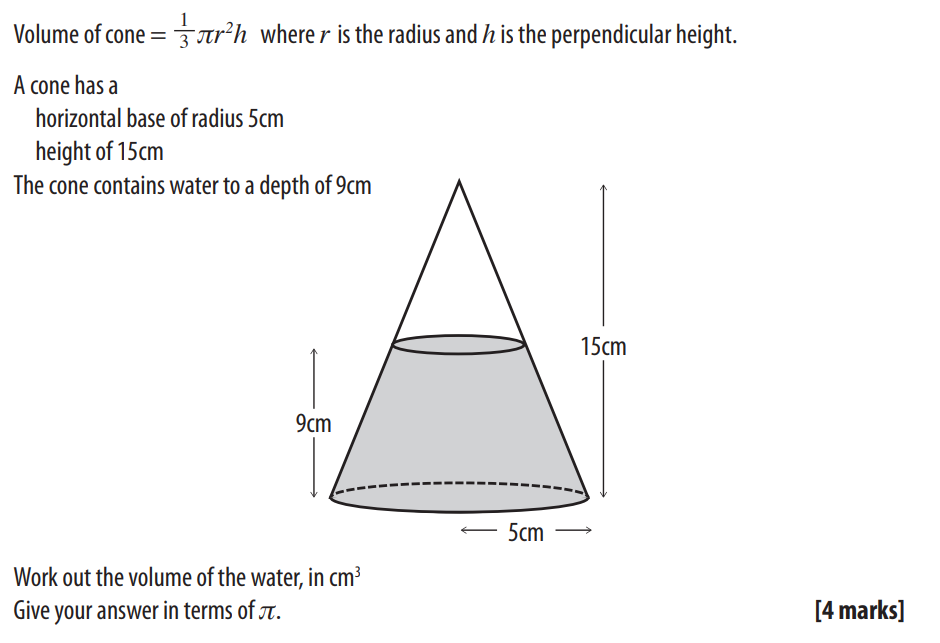
Some problems are cognitively demanding for both experts and novices. However, experts have automated the basic knowledge involved (Ericsson & Kintsch, 1995). They do not need to think about what each term in the formula means, how to square 5, how to find a third, or what to do with the pi symbol. This frees up cognitive capacity to focus on the global features of the problem, such as interpreting the question correctly and devising a strategy for solving it (Chi, Feltovich, & Glaser, 1981). Experts are more likely to solve the problem and learn from the experience (Sweller, van Merriënboer, & Paas, 2019).
Novices may get bogged down in the minutiae of the problem, experience cognitive overload, and learn nothing transferable (Sweller, 1988).
Stages of skill development
Skill development progresses through overlapping phases. Building automaticity begins with understanding concepts and procedures through explicit instruction (Rosenshine, 2012). Extensive repetition builds speed and accuracy (Ericsson, Krampe, & Tesch-Römer, 1993), with continued practice until responses become automatic (Logan, 1988).
Achieving fluency extends beyond automaticity. Students must learn multiple approaches to the same problems (Star & Rittle-Johnson, 2008) and practise applying skills in varied contexts (National Mathematics Advisory Panel, 2008). Fluency develops when students link procedures to underlying principles (Rittle-Johnson, Siegler, & Alibali, 2001) and learn to choose the most appropriate strategy for specific situations (Siegler, 1996).
Fluency has three interconnected dimensions. Speed and accuracy include rapid, correct responses without hesitation, consistent performance across problem variations, maintained accuracy under time pressure, and minimal errors on routine calculations. Flexibility appears when students have multiple solution strategies available, can switch between methods as appropriate, adapt their approach based on problem characteristics, and use efficient methods for specific contexts. Understanding shows when students can explain why procedures work, connect procedures to underlying concepts, recognise when methods apply or do not apply, and use knowledge to verify the reasonableness of answers.
Building fluency in the classroom
Systematic development follows a progression across four stages. Understanding establishes the conceptual foundation through worked examples and explanations, assessed by whether students can explain the procedure. Accuracy focuses on correct execution through guided practice and feedback, assessed by high accuracy on untimed work. Speed develops efficient performance through timed practice and drilling, assessed by quick responses whilst accuracy is maintained. Flexibility addresses strategy selection through exposure to multiple methods and problem variety, assessed by whether students choose appropriate strategies.
Effective instruction follows several principles. Sufficient practice requires extensive repetition beyond initial success to achieve automaticity (Ericsson & Kintsch, 1995). Distributed practice uses spaced review to maintain fluency over time (Cepeda et al., 2006). Progressive complexity increases challenge as fluency develops (van Merriënboer et al., 2003). Multiple contexts provide practice in varied situations to build flexible application (National Mathematics Advisory Panel, 2008).
Objections
The ‘understanding versus memorisation’ dichotomy presents a false choice. Fluency requires both understanding and automaticity working together (Rittle-Johnson, Siegler, & Alibali, 2001). Automated knowledge frees working memory for complex thinking (Cowan, 2001), enables pattern recognition and strategic thinking (Chase & Simon, 1973), supports problem-solving in novel contexts (Chi, Feltovich, & Glaser, 1981), and reduces cognitive load during learning (Sweller, van Merriënboer, & Paas, 2019).
‘Drill and kill’ concerns arise from poorly designed practice rather than from repetition itself. Quality practice is based on solid conceptual understanding (Rittle-Johnson, Siegler, & Alibali, 2001), uses varied and engaging formats, maintains appropriate challenge levels (van Merriënboer et al., 2003), and includes clear purpose and progress monitoring.
References
Cepeda, N. J., Pashler, H., Vul, E., Wixted, J. T., & Rohrer, D. (2006). Distributed practice in verbal recall tasks: A review and quantitative synthesis. Psychological Bulletin, 132(3), 354–380. https://doi.org/10.1037/0033-2909.132.3.354
Chase, W. G., & Simon, H. A. (1973). Perception in chess. Cognitive Psychology, 4(1), 55–81. https://doi.org/10.1016/0010-0285(73)90004-2
Chi, M. T. H., Feltovich, P. J., & Glaser, R. (1981). Categorization and representation of physics problems by experts and novices. Cognitive Science, 5(2), 121–152. https://doi.org/10.1207/s15516709cog0502_2
Cowan, N. (2001). The magical number 4 in short-term memory: A reconsideration of mental storage capacity. Behavioral and Brain Sciences, 24(1), 87–114. https://doi.org/10.1017/S0140525X01003922
Ericsson, K. A., & Kintsch, W. (1995). Long-term working memory. Psychological Review, 102(2), 211–245. https://doi.org/10.1037/0033-295X.102.2.211
Ericsson, K. A., Krampe, R. T., & Tesch-Römer, C. (1993). The role of deliberate practice in the acquisition of expert performance. Psychological Review, 100(3), 363–406. https://doi.org/10.1037/0033-295X.100.3.363
Logan, G. D. (1988). Toward an instance theory of automatization. Psychological Review, 95(4), 492–527. https://doi.org/10.1037/0033-295X.95.4.492
National Mathematics Advisory Panel. (2008). Foundations for success: The final report of the National Mathematics Advisory Panel. U.S. Department of Education.
Rittle-Johnson, B., Siegler, R. S., & Alibali, M. W. (2001). Developing conceptual understanding and procedural skill in mathematics: An iterative process. Journal of Educational Psychology, 93(2), 346–362. https://doi.org/10.1037/0022-0663.93.2.346
Rosenshine, B. (2012). Principles of instruction: Research-based strategies that all teachers should know. American Educator, 36(1), 12–19.
Schneider, W., & Shiffrin, R. M. (1977). Controlled and automatic human information processing: I. Detection, search, and attention. Psychological Review, 84(1), 1–66. https://doi.org/10.1037/0033-295X.84.1.1
Siegler, R. S. (1996). Emerging minds: The process of change in children’s thinking. Oxford University Press.
Star, J. R., & Rittle-Johnson, B. (2008). Flexibility in problem solving: The case of equation solving. Learning and Instruction, 18(6), 565–579. https://doi.org/10.1016/j.learninstruc.2007.09.018
Sweller, J. (1988). Cognitive load during problem solving: Effects on learning. Cognitive Science, 12(2), 257–285. https://doi.org/10.1207/s15516709cog1202_4
Sweller, J., van Merriënboer, J. J. G., & Paas, F. (2019). Cognitive architecture and instructional design: 20 years later. Educational Psychology Review, 31(2), 261–292. https://doi.org/10.1007/s10648-019-09465-5
van Merriënboer, J. J. G., Kirschner, P. A., & Kester, L. (2003). Taking the load off a learner’s mind: Instructional design for complex learning. Educational Psychologist, 38(1), 5–13. https://doi.org/10.1207/S15326985EP3801_2