Key ideas
Core concepts
- Problem-solving, creativity and critical thinking are biologically primary skills that develop without instruction.
- Applying these skills in any domain depends on extensive subject-specific knowledge, so schools develop them through a knowledge-based curriculum and explicit teaching rather than through generic skills lessons.
The term 21st Century Skills refers to abilities including Problem-Solving, creativity, critical thinking, collaboration, communication, and resilience. These skills have existed throughout human history. Some commentators view the “21st century” label as marketing rather than pedagogical innovation.
Connected to
Biologically Primary & Secondary Knowledge | Problem-Solving | Knowledge-Based Curriculum | Explicit Teaching
Biologically primary skills
Advocates of approaches like inquiry-based learning argue that it is the best method to develop these 21st Century Skills. However, Cognitive Load Theory suggests that these general skills are biologically primary and do not require instruction.
Sweller (2019)
Over the last few decades, many educationalists, correctly realising the importance of such biologically primary skills, have advocated that they be taught. Such campaigns tend to fail, not because the skills are unimportant but because they are of such importance to humans that we have evolved to acquire them automatically without instruction.
Domain-specific knowledge
Applying these skills requires domain-specific knowledge (Willingham, 2007; Chi et al., 1981). In mathematics, problem-solving depends on knowledge of facts and procedures (Sweller, 1988); in music, creativity requires proficiency with instruments and understanding of theory (Ericsson et al., 1993). Critical thinking on any subject requires substantial knowledge of that subject (Willingham, 2007). These skills are manifestations of domain expertise rather than generic transferable abilities (Tricot & Sweller, 2014).
Novices and experts
The primary difference between novices and experts in a given domain is that experts possess a greater amount of relevant domain-specific knowledge (Chi et al., 1981). The development of 21st-century skills therefore requires a Knowledge-Based Curriculum and Explicit Teaching.
Memorisation and future skills
Some commentators make confident predictions about the unknowable future and use that to further their progressive education agendas.
Howard Gardner at the OECD Educating for Innovative Societies Conference (2012)
When the answers to factual questions are available at the click of a button, there is no point in spending time committing the information to memory … going forward, our focus in schools … should be on understanding the methods by which assertions are made, the way that a question is posed, how relevant data and arguments are marshaled, what kinds of challenges have been considered, how they have been responded to …
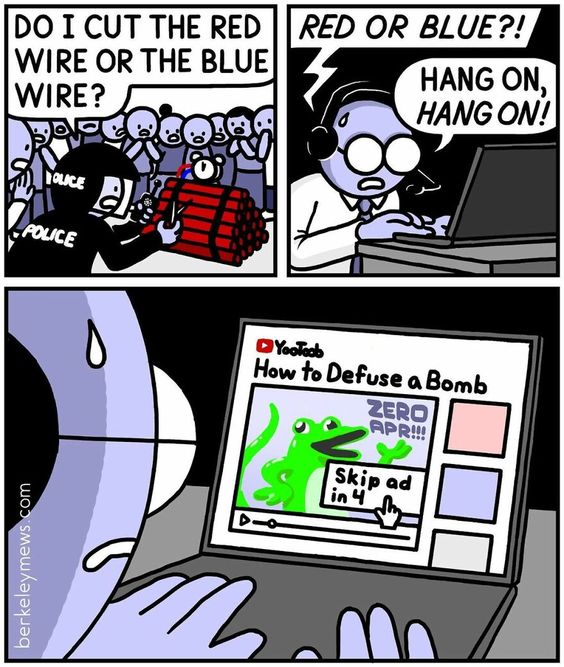
Having access to a vast repository of information is nothing new; libraries have existed for millennia. Students cannot think critically or make informed judgements about information without automaticity in recalling the relevant domain knowledge. Being fluent in that knowledge and integrating it into existing schemas is more effective than having information available at a click: a reader who must look up every unfamiliar word, then judge which definition applies, cannot focus on comprehension.
References
Chi, M. T. H., Feltovich, P. J., & Glaser, R. (1981). Categorization and representation of physics problems by experts and novices. Cognitive Science, 5(2), 121-152. https://doi.org/10.1207/s15516709cog0502_2
Ericsson, K. A., Krampe, R. T., & Tesch-Römer, C. (1993). The role of deliberate practice in the acquisition of expert performance. Psychological Review, 100(3), 363-406. https://doi.org/10.1037/0033-295X.100.3.363
Gardner, H. (2012). Address to the OECD Educating for Innovative Societies Conference. Organisation for Economic Co-operation and Development.
Sweller, J. (1988). Cognitive load during problem solving: Effects on learning. Cognitive Science, 12(2), 257-285. https://doi.org/10.1207/s15516709cog1202_4
Sweller, J., van Merriënboer, J. J. G., & Paas, F. (2019). Cognitive architecture and instructional design: 20 years later. Educational Psychology Review, 31(2), 261-292. https://doi.org/10.1007/s10648-019-09465-5
Tricot, A., & Sweller, J. (2014). Domain-specific knowledge and why teaching generic skills does not work. Educational Psychology Review, 26(2), 265-283. https://doi.org/10.1007/s10648-013-9243-1
Willingham, D. T. (2007). Critical thinking: Why is it so hard to teach? American Educator, 31(2), 8-19.