Key ideas
Core concepts
- Success builds motivation more effectively than constant struggle and failure. Students need the necessary tools and knowledge before engaging in challenging tasks, otherwise struggle produces frustration.
- Growth-mindset findings vary by intervention and context; null findings do not establish that every such intervention is ineffective.
Definition
Struggle refers to challenging learning experiences that can be productive when students have foundational knowledge and tools, but counterproductive when they lead to cognitive overload and frustration.
Connected to
Non-Explicit Teaching | Motivation | Explicit Teaching | Cognitive Load Theory
Curiosity appears universal in humans, and the brain rewards problem-solving with dopamine. However, the process of thinking becomes frustrating when students lack the necessary tools to overcome a challenge. Struggle without foundation produces frustration, not growth.
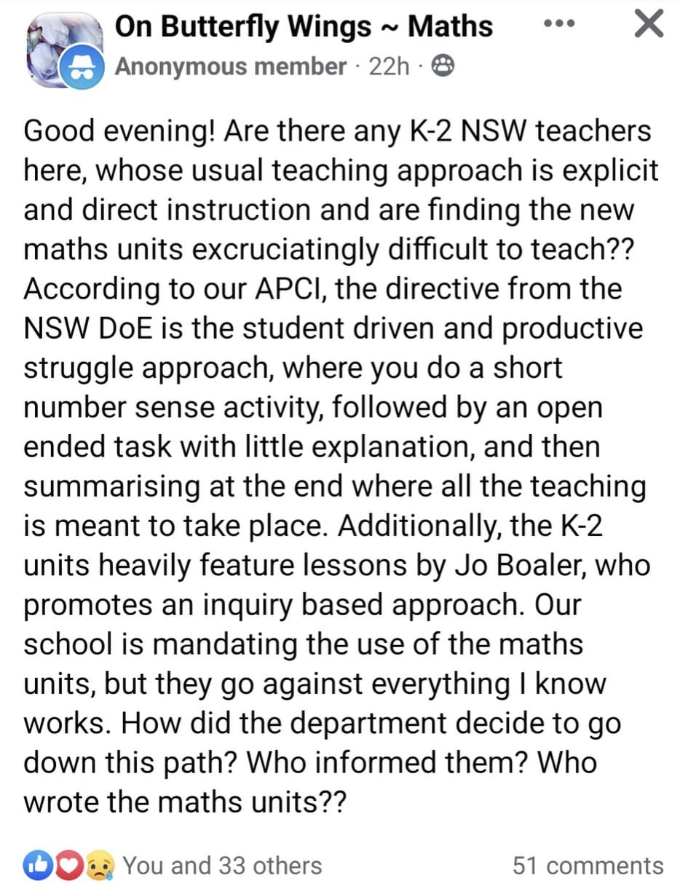
Jo Boaler (2016) explains in a YouCubed video that “a research study found that when people make mistakes their brains grew more than when they got work right”, attributing this to the dual-firing of synapses. This concept of “productive struggle” has been integrated into some primary mathematics curricula, suggesting that making mistakes can be beneficial for learning.
Struggle and motivation
Mistakes, struggle, and failure are not inherently keys to learning. Whilst they play a role, they can also have the opposite effect if not managed correctly. A key element of motivation is the feeling of success or the belief that success is within reach (Garon-Carrier et al., 2016). Students tend to enjoy activities they are good at or believe they can become good at, this represents human psychology, not character flaw. Presenting students with tasks that are too complex and lead to cognitive overload can result in frustration and disengagement (Sweller et al., 2019).
Teachers structure tasks to present an appropriate level of challenge for students. For novices, this often means employing explicit teaching to ensure that students have the foundational knowledge required to tackle more complex problems later. Struggling, failing, making mistakes, and learning from them are elements of mathematical development, but a curriculum should focus on ensuring success, not failure. Success builds capacity for productive struggle; failure without foundation builds avoidance.
Growth mindset
The idea that instilling a growth mindset in students can help them cope with challenges and view failures as learning opportunities has gained widespread popularity in education. According to Carol Dweck’s concept (Dweck, 2006), students with a growth mindset do not give up easily; they embrace challenges, work hard, and see mistakes as opportunities to learn.
Sisk et al. (2018) reported weak average associations and intervention effects, with possible benefits for some disadvantaged or academically at-risk students. Li and Bates (2019) found no support for their predicted mindset effects. In contrast, Yeager et al. (2019) found a small achievement benefit for lower-achieving ninth-grade pupils in a large US trial, with effects varying by school context. These findings support a qualified view rather than a universal claim of success or failure.
Interpretation in schools
The work of Boaler and Dweck does not say students should struggle and fail all the time, but this is how it has been interpreted in many schools. Emphasising struggle in the mistaken belief that educators can produce gritty, determined students with growth mindsets overlooks the importance of success. Success is the foundation upon which motivation is built (Bandura, 1997).
References
Yeager, D. S., et al. (2019). A national experiment reveals where a growth mindset improves achievement. Nature, 573, 364-369. https://doi.org/10.1038/s41586-019-1466-y
Bandura, A. (1997). Self-efficacy: The exercise of control. W. H. Freeman.
Boaler, J. (2016). Mathematical mindsets: Unleashing students’ potential through creative math, inspiring messages and innovative teaching. Jossey-Bass.
Dweck, C. S. (2006). Mindset: The new psychology of success. Random House.
Garon-Carrier, G., Boivin, M., Guay, F., Kovas, Y., Dionne, G., Lemelin, J. P., Séguin, J. R., Vitaro, F., & Tremblay, R. E. (2016). Intrinsic motivation and achievement in mathematics in elementary school: A longitudinal investigation of their association. Child Development, 87(1), 165-175. https://doi.org/10.1111/cdev.12458
Li, Y., & Bates, T. C. (2019). You can’t change your basic ability, but you work at things, and that’s how we get hard things done: Testing the role of growth mindset on response to setbacks, educational attainment, and cognitive ability. Journal of Experimental Psychology: General, 148(9), 1640-1655. https://doi.org/10.1037/xge0000669
Sisk, V. F., Burgoyne, A. P., Sun, J., Butler, J. L., & Macnamara, B. N. (2018). To what extent and under which circumstances are growth mind-sets important to academic achievement? Two meta-analyses. Psychological Science, 29(4), 549-571. https://doi.org/10.1177/0956797617739704
Sweller, J., van Merriënboer, J. J. G., & Paas, F. (2019). Cognitive architecture and instructional design: 20 years later. Educational Psychology Review, 31(2), 261-292. https://doi.org/10.1007/s10648-019-09465-5