Key ideas
Core concepts
- Actively recalling information strengthens memory more than re-reading notes (Roediger & Karpicke, 2006).
- Spacing retrieval at daily, weekly, and monthly intervals builds automaticity and prevents forgetting (Cepeda et al., 2006).
- Mixing topics forces strategy selection and discrimination between methods (Rohrer & Taylor, 2007).
- Retrieval practice only works once students have learnt the material initially.
Retrieval practice is students actively recalling information from long-term memory to working memory, which strengthens memory pathways more than passive review (Roediger & Karpicke, 2006). The testing effect, documented across decades of cognitive research, provides the empirical foundation for this approach (Roediger & Butler, 2011). It works when students have learnt the material initially, when practice is spaced over time rather than massed (Cepeda et al., 2006), and when topics are interleaved rather than blocked (Rohrer & Taylor, 2007). Common implementations include starter activities, low-stakes quizzes, and homework assignments.
Numerical success cut-offs below are planning heuristics, not validated class-wide progression thresholds. Check individual understanding as well as the class response.
Connected to
Spacing Effect | Interleaving Effect | Cognitive Load | Memory | Self-Explanation Effect | Responsive Teaching | Mathemagenic Activities
The evidence
Retrieval practice uses the testing effect, in which retrieving information from memory enhances future recall more effectively than passive review (Roediger & Karpicke, 2006; Karpicke & Blunt, 2011). Actively recalling information strengthens memory pathways more effectively than passive review (Karpicke & Roediger, 2008), and the process optimises germane load (Sweller, van Merriënboer, & Paas, 2019).
A comprehensive review evaluated ten commonly used learning techniques on their effectiveness and generalisability across different learners and materials, assigning utility ratings based on research evidence (Dunlosky, Rawson, Marsh, Nathan, & Willingham, 2013). Practice testing (retrieval practice) and distributed practice (spacing) received the highest ratings, showing consistent benefits across diverse conditions, learners, and materials: practice testing improves long-term retention more than rereading, whilst distributed practice is more effective than massed practice. Elaborative interrogation (generating explanations), self-explanation (relating new to known information), and interleaved practice received moderate ratings; these show promise but require more training or have limited applicability. Summarisation, highlighting/underlining, keyword mnemonics, imagery for text, and rereading received low ratings. These widely used techniques provide minimal benefit compared to retrieval practice and spaced practice: students often highlight too much or inappropriate content, whilst rereading creates familiarity without strengthening retrieval pathways.
Students should be taught high-utility strategies and understand why they work, since many popular study techniques provide minimal learning benefit compared to active retrieval and distributed practice (Dunlosky et al., 2013).
Essential prerequisite
Students must have properly learnt the content before being quizzed on it (Agarwal et al., 2021). For struggling students who haven’t understood the material, retrieval practice becomes ineffective as they’re consolidating nothing but rather guessing at “thin air of vaguely-encountered wisps of disconnected factoids from a dim past”. This can highlight gaps but may demotivate students rather than strengthen memory.
Opportunities for retrieval practice
Effective implementation embeds retrieval practice throughout the learning cycle (Agarwal et al., 2021). Four types of activity support knowledge retention. “Do Now” activities use four mixed questions with an 80% target success rate, taking five minutes for independent work and five minutes for review; they draw on spaced retrieval unrelated to the current lesson to build automaticity across topics. Low-stakes quizzes mix topics from various previous units in a closed-book format, typically running weekly for 15-20 minutes to provide systematic review and diagnosis. Homework assignments employ spaced mixed practice of previously learnt content for consolidation and retention. Interweaving embeds old topics within new lessons on a daily basis, placing prior topics in current context to maintain skills and discrimination between methods.
”Do Now” activities
“Do Now” activities follow a specific structure. Each session uses exactly four questions from different topics, pitched at an 80% success rate (Rosenshine, 2012). Students work independently for five minutes, followed by five minutes of review. Teachers typically use mini-whiteboards for whole-class response, addressing one question at a time. Responsive Teaching informs the review: if fewer than 80% answer correctly, the teacher models the solution and rechecks understanding; if more than 80% answer correctly, the teacher confirms the answer and moves on. A “Do Now” might include fractions from three weeks ago, angles from last week, algebra from yesterday, and a prerequisite concept for today’s lesson.
Low-stakes quizzes
Low-stakes quizzes require complete silence to ensure individual retrieval rather than recognition. The content mixes topics from various previous units, with difficulty targeted at 80% average success rate to maintain motivation. The closed-book format ensures genuine retrieval. Quizzes typically run 15-20 minutes with extension questions for early finishers. Friday quizzes might mix percentages, area, equations, and statistics rather than testing topics in isolation, which forces students to discriminate between methods.
The quiz process follows a consistent sequence. Before attempting questions, students rate their confidence in potential answers on a 1-5 scale. Immediate feedback follows through self or peer assessment. Students then self-explain incorrect answers, with attention to high-confidence errors. Personal progress tracking in dedicated folders allows students to monitor their development over time, and teachers use quiz data to address common misconceptions identified across the class.
Daily review and spaced quizzes
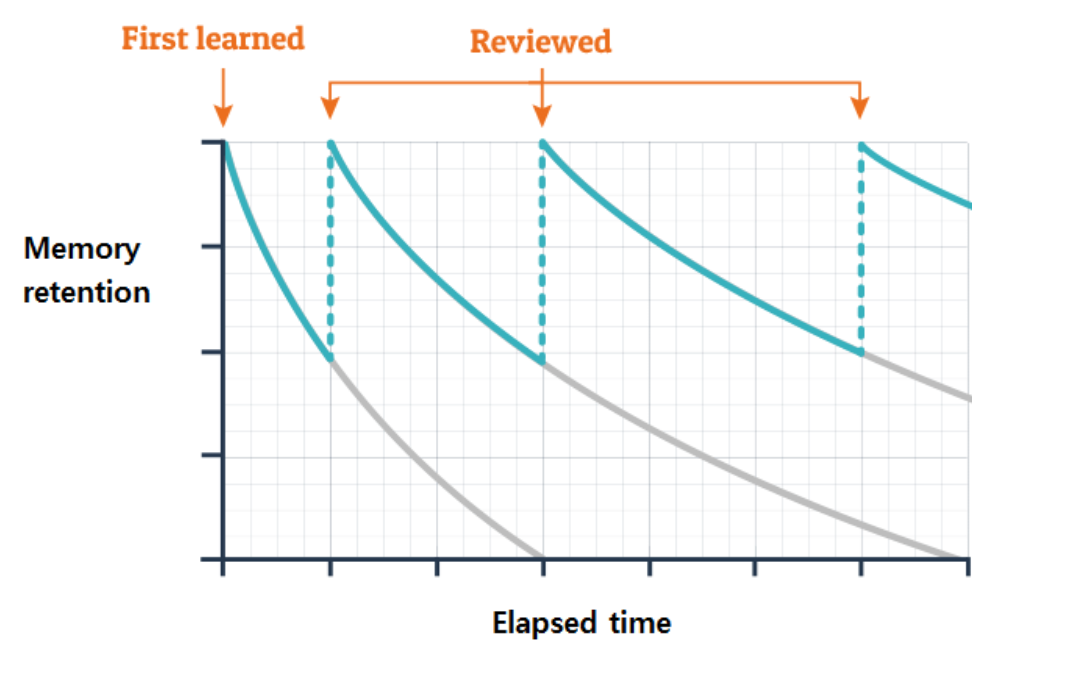
Retrieval practice requires structured opportunities for active recall across daily, weekly, and monthly intervals. The approach must follow initial learning, as students need to understand content before retrieval practice begins. Teachers use mini-whiteboards, ensure silent individual work, provide immediate feedback, and track progress data. The forgetting curve shows rapid memory loss without systematic review, whilst spacing and interleaving optimise long-term retention.
The approach provides diagnostic data about student understanding for teachers, identifies topics requiring reteaching, and informs future lesson planning and curriculum pacing. For students, the practice builds long-term retention and automaticity, develops metacognitive awareness of their learning, and promotes consistent study habits over cramming. Regular, low-stakes practice reduces anxiety and creates opportunities for success and confidence building.
Limitations and cautions
Students must understand content before retrieval practice begins. Otherwise they consolidate guesswork rather than knowledge. Recognition through multiple choice differs from recall, so open-ended questions provide better practice. Making quizzes high-stakes increases anxiety and reduces learning benefits. Massed practice is less effective than distributed practice, so spacing remains essential. Struggling students need extra support to avoid demotivation from repeated failure.
References
Agarwal, P. K., Nunes, L. D., & Blunt, J. R. (2021). Retrieval practice consistently benefits student learning: A systematic review of applied research in schools and classrooms. Educational Psychology Review, 33(4), 1409-1453. https://doi.org/10.1007/s10648-021-09595-9
Cepeda, N. J., Pashler, H., Vul, E., Wixted, J. T., & Rohrer, D. (2006). Distributed practice in verbal recall tasks: A review and quantitative synthesis. Psychological Bulletin, 132(3), 354-380. https://doi.org/10.1037/0033-2909.132.3.354
Dunlosky, J., Rawson, K. A., Marsh, E. J., Nathan, M. J., & Willingham, D. T. (2013). Improving students’ learning with effective learning techniques: Promising directions from cognitive and educational psychology. Psychological Science in the Public Interest, 14(1), 4-58. https://doi.org/10.1177/1529100612453266
Karpicke, J. D., & Blunt, J. R. (2011). Retrieval practice produces more learning than elaborative studying with concept mapping. Science, 331(6018), 772-775. https://doi.org/10.1126/science.1199327
Karpicke, J. D., & Roediger, H. L. (2008). The critical importance of retrieval for learning. Science, 319(5865), 966-968. https://doi.org/10.1126/science.1152408
Roediger, H. L., & Butler, A. C. (2011). The critical role of retrieval practice in long-term retention. Trends in Cognitive Sciences, 15(1), 20-27. https://doi.org/10.1016/j.tics.2010.09.003
Roediger, H. L., & Karpicke, J. D. (2006). Test-enhanced learning: Taking memory tests improves long-term retention. Psychological Science, 17(3), 249-255. https://doi.org/10.1111/j.1467-9280.2006.01693.x
Rohrer, D., & Taylor, K. (2007). The shuffling of mathematics problems improves learning. Instructional Science, 35(6), 481-498. https://doi.org/10.1007/s11251-007-9015-8
Rosenshine, B. (2012). Principles of instruction: Research-based strategies that all teachers should know. American Educator, 36(1), 12-19, 39.
Sweller, J., van Merriënboer, J. J. G., & Paas, F. (2019). Cognitive architecture and instructional design: 20 years later. Educational Psychology Review, 31(2), 261-292. https://doi.org/10.1007/s10648-019-09465-5
Wilson, M., Scalise, K., & Gochyyev, P. (2019). Measuring growth in learning: Monitoring instruction with learning progressions. Measurement: Interdisciplinary Research and Perspectives, 17(3), 119-141. https://doi.org/10.1080/15366367.2019.1593777