Key ideas
Core concepts
- Mathematical concepts can be represented in concrete, pictorial, and abstract forms, and each form offers different insights.
- Concrete and pictorial models have limits, so students should move toward abstract representations over time.
- Teachers favour symbolic forms whilst many students prefer pictorial ones.
- Good teaching moves fluently between all three representations.
Concrete Pictorial Abstract (CPA) is a teaching approach that uses multiple mathematical representations (physical materials, visual diagrams, and symbols) to build conceptual understanding.
Connected to
Solution Comparison | Teach Methods that Last | Knowledge-Based Curriculum | Prior Knowledge
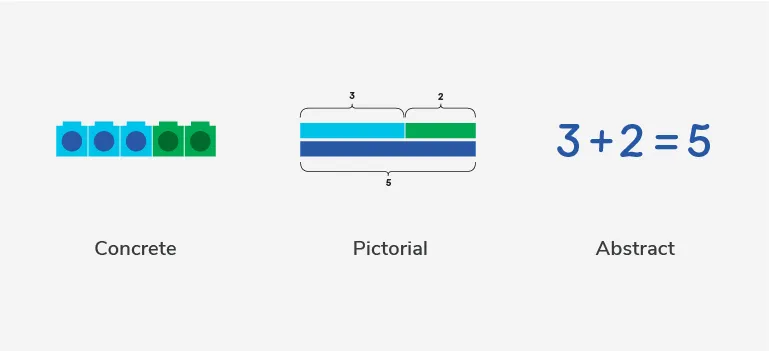
Representations of mathematical ideas
Mathematical ideas, principles, and relationships can be expressed verbally, visually, and symbolically (Bruner, 1966). Each representation offers different insights into a concept (Ainsworth, 2006), and effective mathematics teaching requires students to move fluently between multiple representations of the same idea (Pape & Tchoshanov, 2001).
Bruner (1960) proposed that learning should progress through three modes of representation: enactive (learning by doing through physical manipulation), iconic (learning through images and diagrams), and symbolic (learning through abstract symbols and language). CPA follows this progression. Students construct understanding more readily when they begin with physical experience, then move to visual representations, and finally to abstract symbols. Bruner’s spiral curriculum principle adds that important concepts should be revisited at increasing levels of sophistication, moving from concrete to abstract over time.
Familiar examples and abstraction
People understand new things in the context of things they already know, and most of what people know is concrete (Willingham, 2009). Abstract concepts are difficult to understand without concrete foundations. Students cannot understand metaphors or analogies when they lack understanding of the concrete elements being referenced. “Mitochondria are the powerhouse of the cell” means nothing to students who do not understand what powerhouses do or how power generation works.
New abstract ideas connect to existing concrete knowledge through analogies, examples, and models, but these connections work only when students possess the necessary concrete understanding. Teachers should check that students have the concrete knowledge required before introducing abstract concepts. This does not mean avoiding abstraction. It means building abstraction from concrete foundations that students actually possess.
The progression from concrete to abstract should be deliberate. Before introducing abstract symbols, assess whether students have the concrete knowledge needed to understand the planned analogies or examples. Multiple concrete examples work better than a single analogy that may not connect with all students.
Representation preferences and biases
Student and teacher preferences create predictable patterns that can either support or hinder learning. Knowing these biases lets teachers make deliberate decisions that counteract them.
Low-achieving students tend to prefer pictorial representations whilst high-achieving students often favour symbolic representations (Koedinger et al., 2008). Students generally gravitate toward familiar representation types.
Mathematics teachers show bias toward symbolic representations (Nathan, 2012). Symbolic forms are viewed as more “mathematical” and worthy of classroom time, so teachers encourage symbolic work even when it is not the most efficient choice, which undermines strategic representation selection (Nathan, 2012). Teacher preferences also shape student perceptions of mathematical validity, so symbolic approaches come to dominate regardless of appropriateness.
Limits of concrete and pictorial models
Concrete and pictorial representations provide conceptual foundations but have inherent limits (McNeil & Jarvin, 2007; Uttal et al., 1997). Time costs grow as quantities become larger, making models inefficient for complex calculations. Some concepts cannot be modelled adequately: negatives are poorly shown in bar models. Overgeneralisation occurs when fraction circles always show equal divisions, leaving students struggling with real-world unequal divisions. Models also break down with advanced concepts, which limits their transfer to higher mathematics.
Students need extensive practice moving fluently between representations, but should ultimately progress toward more abstract models (Fyfe et al., 2014; Rittle-Johnson & Alibali, 1999). Symbolic representations handle larger quantities and complex operations more efficiently, apply across broader mathematical contexts, and are required for higher-level concepts (Nathan, 2012). Expert mathematicians work primarily with abstract representations.
Choosing a model
Selecting the appropriate model requires understanding the mathematical concept being taught and what each representation type affords.
Number lines suit rational number operations, fraction concepts, and integer arithmetic (Fuson & Briars, 1990). They are versatile tools for illustrating operations with rational numbers, help students recognise fractions as rational numbers rather than discrete quantities, and show relationships between different number types. Applications include addition or subtraction of integers, fraction ordering, and decimal placement.
Integer counter models suit integer operations and zero-pair concepts. Two different coloured counters represent positive and negative integers, illustrating the zero-pairs concept clearly and supporting addition or subtraction of integers. The model becomes unwieldy with larger numbers.
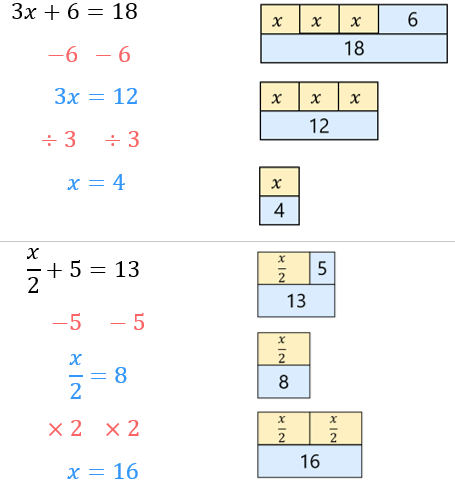
Bar models suit linear equations, fact families, and proportional reasoning. They illustrate relationships in word problems, bridge arithmetic and algebraic thinking, and give a clear representation of known and unknown quantities. Applications include simple linear equations like 3x + 5 = 17, fact family relationships, and part-whole problems. Their main limit is that bar models become complex with negative numbers, so transition to symbolic work before introducing negatives.
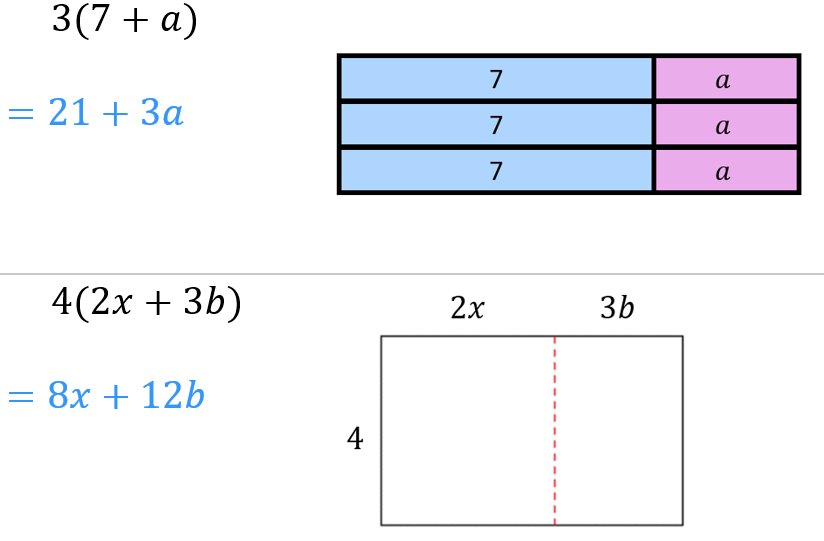
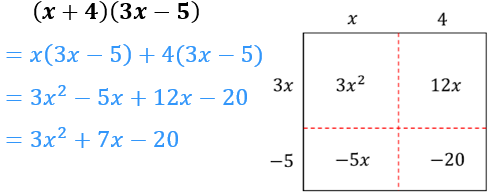
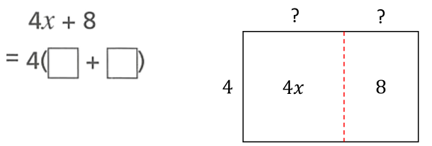
Area models suit the distributive law, polynomial operations, and factorisation. Applications include binomial expansion like (x + 3)(x + 5), trinomial expansions, factorisation, and even surds and imaginary numbers. The model must be configured for each type of problem. An example progression: simple multiplication like 23 × 15, binomial products like (x + 4)(x + 7), then factorisation like x² + 11x + 28.
Ratio boxes suit proportional reasoning and similar figures. Applications include setting up proportional equations, solving ratio problems, similar triangle calculations, and scale factor problems. The structure gives a clear visual representation of relationships between quantities.
Sequencing representations in lessons
Plan the representation sequence by assessing prior knowledge of different representation types, selecting a starting point based on concept complexity and student familiarity, planning the pathway from concrete through pictorial to abstract, identifying the points where students are ready for the next representation level, and building fluency in moving between representations before advancing.
Do not assume students automatically see connections between representations. Show how the same concept appears in each form, practise translating between representations, and discuss the advantages and limits of each approach. Solution Comparison is useful for examining different approaches to the same problem.
Several errors recur when teachers adopt CPA. Over-reliance on concrete representations: plan a clear progression toward abstraction based on student readiness rather than keeping students with manipulatives too long. Representation isolation: demonstrate the relationships between concrete, pictorial, and abstract forms explicitly rather than teaching each representation separately. Premature abstraction: ensure a solid foundation in concrete or pictorial work before advancing to symbols. Single-method teaching: incorporate all three forms and respect different student preferences rather than using only the teacher’s preferred representation type.
References
Ainsworth, S. (2006). DeFT: A conceptual framework for considering learning with multiple representations. Learning and Instruction, 16(3), 183-198. https://doi.org/10.1016/j.learninstruc.2006.03.001
Bruner, J. S. (1960). The process of education. Harvard University Press.
Bruner, J. S. (1966). Toward a theory of instruction. Harvard University Press.
Fuson, K. C., & Briars, D. J. (1990). Using a base-ten blocks learning and teaching approach for first- and second-grade place-value and multidigit addition and subtraction. Journal for Research in Mathematics Education, 21(3), 180-206. https://doi.org/10.2307/749373
Fyfe, E. R., McNeil, N. M., Son, J. Y., & Goldstone, R. L. (2014). Concreteness fading in mathematics and science instruction: A systematic review. Educational Psychology Review, 26(1), 9-25. https://doi.org/10.1007/s10648-014-9249-3
Koedinger, K. R., Alibali, M. W., & Nathan, M. J. (2008). Trade-offs between grounded and abstract representations: Evidence from algebra problem solving. Cognitive Science, 32(2), 366-397. https://doi.org/10.1080/03640210701863933
McNeil, N. M., & Jarvin, L. (2007). When theories don’t add up: Disentangling the manipulatives debate. Theory Into Practice, 46(4), 309-316. https://doi.org/10.1080/00405840701593899
Nathan, M. J. (2012). Rethinking formalisms in formal education. Educational Psychologist, 47(2), 125-148. https://doi.org/10.1080/00461520.2012.667063
Pape, S. J., & Tchoshanov, M. A. (2001). The role of representation(s) in developing mathematical understanding. Theory Into Practice, 40(2), 118-127. https://doi.org/10.1207/s15430421tip4002_6
Rittle-Johnson, B., & Alibali, M. W. (1999). Conceptual and procedural knowledge of mathematics: Does one lead to the other? Journal of Educational Psychology, 91(1), 175-189. https://doi.org/10.1037/0022-0663.91.1.175
Uttal, D. H., Scudder, K. V., & DeLoache, J. S. (1997). Manipulatives as symbols: A new perspective on the use of concrete objects to teach mathematics. Journal of Applied Developmental Psychology, 18(1), 37-54. https://doi.org/10.1016/S0193-3973(97)90013-7
Willingham, D. T. (2009). Why don’t students like school? A cognitive scientist answers questions about how the mind works and what it means for the classroom. Jossey-Bass.