Key ideas
Core concepts
- Partially completed problems provide an intermediate step between full demonstrations and complete independence, bridging worked examples and independent practice.
- Backwards fading works best: remove final steps first, then work backwards through the solution, rather than removing initial steps.
- Students invest mental effort in completing solutions, creating germane load that strengthens learning.
- Guidance should fade gradually as expertise grows, not disappear abruptly.
The completion problem effect is enhanced learning when students complete partially worked solutions compared to studying complete worked examples, due to germane cognitive load from active problem completion (van Merriënboer, 1990).
Connected to
Worked Examples | Scaffolding | Cognitive Load Theory | Expertise Reversal Effect | Worked-Example Effect | Problem-Solving
The backwards fading sequence
Use backwards fading (van Merriënboer, 1990; Renkl, Atkinson, & Maier, 2000): show complete worked example, provide example with final step missing, remove final two steps, continue removing steps backwards, then progress to independent practice.
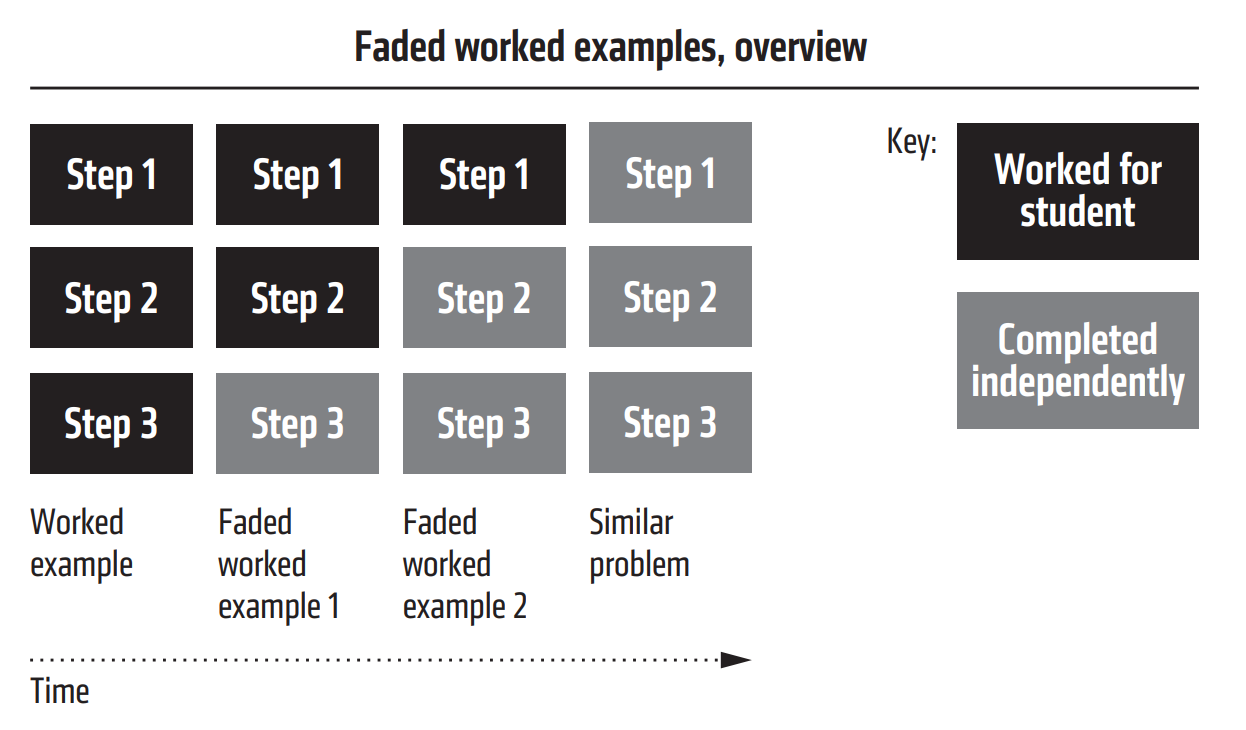
Problem-solving demands during fading
Backwards fading is more effective than forward fading for several reasons (van Merriënboer, 1990). Students see the complete solution structure first, understanding the full procedure before attempting parts (Renkl et al., 2000). Final steps often involve simplification and are less conceptually complex, making initial independent work achievable. Working backwards maintains problem coherence. Students always see where they are heading. Each step removal increases cognitive load incrementally but manageably, avoiding sudden jumps in difficulty (Renkl & Atkinson, 2003).
Forward fading (removing first steps) leaves students without clear problem setup. They do not know where to begin. Initial steps are often most conceptually demanding, overwhelming students when removed first. Students may struggle to understand problem structure when the foundation is missing. This explains why backwards fading consistently outperforms forward fading in research studies (van Merriënboer, 1990; Renkl et al., 2000).
Guidance-fading effect
Completion problems exemplify the broader guidance-fading effect: systematic guidance reduction as learner expertise increases, consistent with Expertise Reversal Effect (Renkl & Atkinson, 2003; Kalyuga et al., 2003). As students develop competence, reduce support gradually rather than abruptly removing all scaffolding.
This graduated approach respects working memory limitations whilst building towards independence (Cowan, 2001). Too much support wastes time for capable learners; too little overwhelms developing learners. Backwards fading balances these competing demands (van Merriënboer, 1990).
Premature fading and missing prerequisites
Several errors undermine effective use of completion problems. Rushed fading removes scaffolding too quickly. Monitor student success rates to guide the pace of step removal. Premature start means students begin fading before understanding the complete procedure. They need the full picture first. Universal application assumes backwards fading suits all problem types. Consider whether the problem structure supports working backwards. Ignoring expertise means providing completion problems to experts, offering unnecessary scaffolding that wastes time rather than supporting learning.
Completion problems in algebra, writing and division
In algebra, show complete solution to 2x + 5 = 13, then provide problems with final step missing (2x = 8, x = ?), gradually working backwards. For essay paragraphs, provide complete paragraph, then remove concluding sentence, then remove evidence explanation, working backwards through structure. For long division, show complete calculation, then provide problems missing final steps, gradually removing more steps working backwards through the algorithm.
References
Cowan, N. (2001). The magical number 4 in short-term memory: A reconsideration of mental storage capacity. Behavioral and Brain Sciences, 24(1), 87-114. https://doi.org/10.1017/S0140525X01003922
Kalyuga, S., Ayres, P., Chandler, P., & Sweller, J. (2003). The expertise reversal effect. Educational Psychologist, 38(1), 23-31. https://doi.org/10.1207/S15326985EP3801_4
Renkl, A., & Atkinson, R. K. (2003). Structuring the transition from example study to problem solving in cognitive skill acquisition: A cognitive load perspective. Educational Psychologist, 38(1), 15-22. https://doi.org/10.1207/S15326985EP3801_3
Renkl, A., Atkinson, R. K., & Maier, U. H. (2000). From studying examples to solving problems: Fading worked-out solution steps helps learning. In Proceedings of the 22nd Annual Conference of the Cognitive Science Society (pp. 393-398). Cognitive Science Society.
van Merriënboer, J. J. G. (1990). Strategies for programming instruction in high school: Program completion vs. program generation. Journal of Educational Computing Research, 6(3), 265-285. https://doi.org/10.2190/4NK5-17L7-TWQV-1EHL